
































Mesh
Mesh nodes: Read, Sample, Write, Operations, Primitives, Topology….
Read
Add menu - Mesh - Read
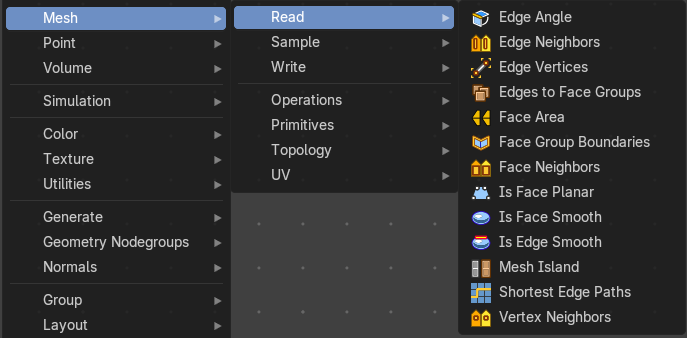
Nodes to modify the mesh geometry.
Cluster by Connected
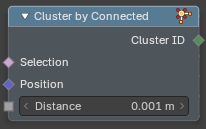
Sorts the vertices of a mesh into groups, but only joins vertices that are connected by an edge and are close together. It works like Cluster by Distance, with the extra rule that two vertices must also share an edge. Use it when nearby vertices of different parts of a mesh must stay apart, for example the tips of two fingers that almost touch.
Inputs
Selection
Data type: Boolean.
Which vertices are put into clusters.
Position
Data type: Vector.
The position used to measure the distance.
Distance
Data type: Float (distance).
Connected vertices that are closer than this value belong to the same cluster.
Outputs
Cluster ID
Data type: Integer.
The number of the cluster of each vertex. The number is the index of the first vertex of the cluster.
How to use
With the five points of the Cluster by Distance example and edges between points 0 and 1, 1 and 2, and 3 and 4, the Cluster ID is 0, 0, 2, 3, 3. Points 1 and 2 are connected but 0.0015 apart, which is more than the Distance of 0.001, so they do not share a cluster.
Edge Angle
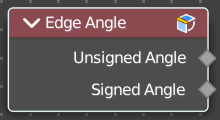
Calculates the angle in radians between two faces that meet at an edge. Without two faces on the edge, the angle will be 0.
Outputs
Unsigned Angle
Data type: Float.
The unsigned output angle. The shortest angle will be picked.
Signed Angle
Data type: Float.
The signed angle between the two faces, where Convex angles are positive and Concave angles are negative. This calculation is slower than the unsigned angle.
Edge Neighbours
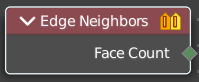
Outputs the number of faces connected to each edge.
Outputs
Face Count
The number of faces.
Edge Vertices
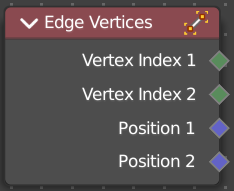
Outputs the index and position of the two vertices that defines an edge. Index outputs an integer. Position a vector.
Outputs
Vertex Index 1
Data type: Integer.
The index of the first vertice.
Vertex Index 2
Data type: Integer.
The index of the second vertice.
Position 1
Data type: Vector.
The position of the first vertice.
Position 2
Data type: Vector.
The position of the second vertice.
Edges to Face Group
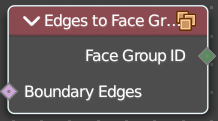
Group Faces into regions, surrounded by the selected boundary edges.
Inuputs
Boundary Edges
The input edges.
Outputs
Face Group ID
The output face group.
Face Area
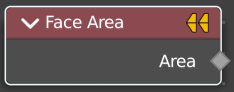
Gives each face area a unique id. Which can be used in a capture attribute for example, to create instances of other geometry to this now unique face areas.
Outputs
Area
Data type: Float.
The face area output.
Face Group Boundaries
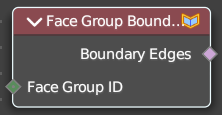
Find edges on the boundaries between face sets
Inputs
—
Face Set
The input face sets to calculate the boundaries from.
Outputs
Boundary Edges
Data type: Boolean.
The edges that lies on the boundaries between the different face sets
Face Count
The face count for the face neighbors.
Face Neighbours
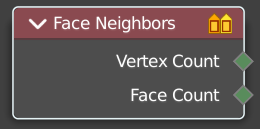
Outputs the number of vertices or faces connected to each face.
Outputs
Vertex Count
The vertex count for the face neighbors.
Face Count
The face count for the face neighbors.
Is Face Planar
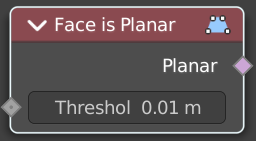
Returns true if all of the points of the evaluated face are on the same plane.
Inputs
Threshold
Data type: Float (distance).
The threshold to consinder the points to be at the same plane.
Outputs
Planar
Data type: Boolean.
True if the face is planar.
Is Face Smooth
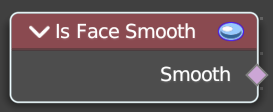
Retreives if the face is shaded smooth.
Outputs
Smooth
Data type: Boolean.
Smooth output.
Is Edge Smooth
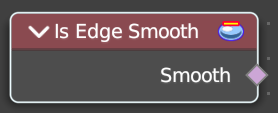
Retreives if the edge is shaded smooth.
Outputs
Smooth
Data type: Boolean.
Smooth output.
Mesh Island
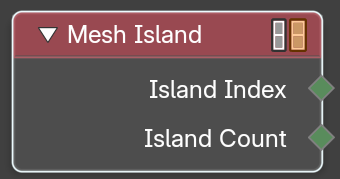
Outputs a separate index for each mesh island. The indices are based on the order of the lowest-numbered vertex in each island.
Outputs
Index Index
The index output.
Island Count
Data type: Integer.
The count output.
Shortest Edge Path
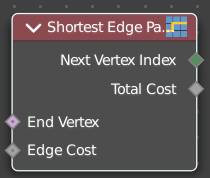
Calculates the shortest path from multiple start points.
Inputs
End Vertex
The last point of the path.
Edge Cost
The amount of calculation to find the shortest path.
Outputs
Next Vertex Index
The vertices index of the shortest path.
Total Cost
The calculation amount.
Vertex Neighbors
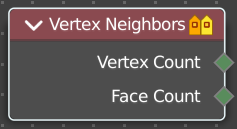
Outputs the number of vertices or faces connected to each vertex.
Outputs
Vertex Count
Data type: Integer.
The vertex count for the vertex neighbors.
Face Count
Data type: Integer.
The face count for the vertex neighbors.
Sample
Add menu - Mesh - Sample

Nodes to modify the mesh geometry.
Sample Nearest Surface
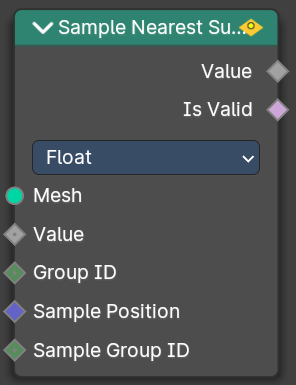
Calculate the interpolated value of a mesh attribute on the closest point of its surface.
Inputs
Mesh
Data type: Geometry.
Input mesh.
Value
Data type: follows the Data Type setting.
The value to calculate.
Group ID
Data type: Integer.
Is evaluated on the face domain, and splits the input mesh into multiple parts, each with its own id.
Sample Position
Data type: Vector.
The sample position to calculate.
Sample Group ID
Data type: Integer.
Determines in which group the closest nearest surface is detected.
Properties
Data Type
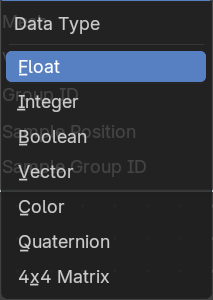
Which data to calculate.
Outputs
Value
Data type: follows the Data Type setting.
The output value.
Is Valid
Data type: Boolean.
Wether the sampling was successful. It is false when the sampled group is empty.
Sample UV Surface
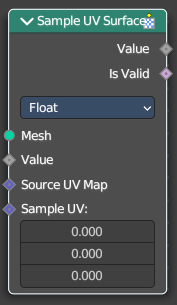
Calculate the interpolated value of a mesh attribute at a UV coordinate.
Inputs
Mesh
Data type: Geometry.
Input mesh.
Value
Data type: follows the Data Type setting.
The value to calculate.
Source UV Map
The input UV map.
Sample UV
Data type: Vector.
The sample position to calculate.
Properties
Data Type
Which data to calculate.
Outputs
Value
Data type: follows the Data Type setting.
The output value.
Is Valid
Data type: Boolean.
Wether the node could find a single face to sample at the uv coordinate.
Write
Add menu - Mesh - Write

These are nodes for working with Mesh data.
Set Mesh Normal
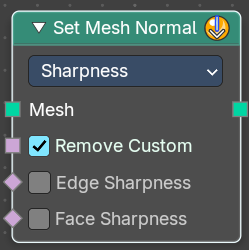
The Set Mesh Normal node is used to modify custom normals on a mesh, providing control over shading smoothness and surface appearance. This is useful for adjustingnormalsmoothness, sharp edges, and tangent-based effects
Input
Mesh
Data type: Geometry.
Input mesh.
Properties
Mode
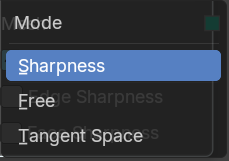
Sharpness
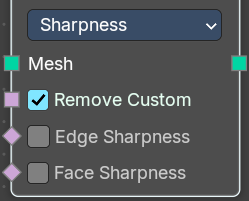
Controls the intensity of edge sharpness. Higher values create stronger shading contrasts between faces.
Store the sharpness of each face or edge. Similar to the "Shade Smooth" and "Shade Flat" operators.
Remove Custom
Removes custom normals previously set by the user on the original mesh data when enabled.
Edge Sharpness
Sets the normal sharpness to the edge domain to “flat”.
Face Sharpness
Sets the normal sharpness to the face domain to “flat”.
Free
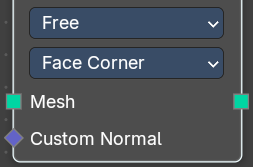
Allows direct manipulation of normals as free vectors, rather than constrained by geometry. Useful for custom shading effects and non-destructive normal adjustments.
Domain
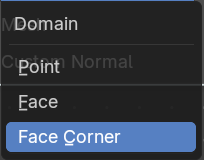
Attribute domain to store the free custom normals.
- Point
- Face
- Face Corner
Note: Default object normals are stored to Facecorner, this will “pass-through” the normal data. Face normals will make “flat” sharp edges.
Tangent Space
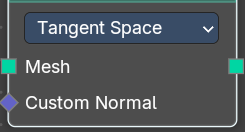
Adjusts normals relative to the surface tangentto store the source meshes normals.Storesnormals in a deformation dependent custom transformation space.
Note: This method is slower, but can be better when subsequent operations change the mesh without handling normals specifically.
Custom Normal
Vector Field based on the normal.
Outputs
Geometry
Geometry output.
Got it! Here's the documentation for the Set Mesh Normal node:
Set Shade Smooth
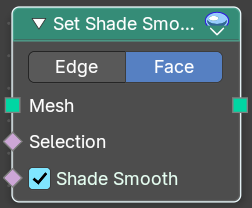
Retrieves if the geometry is shaded smooth.
Input
Geometry
Input mesh.
Selection
Data type: Boolean.
A selection of the input mesh.
Shade Smooth
Data type: Boolean.
Set the shading to smooth.
Properties
Domain
Edge
Set Edge to smooth.
Face
Set Face to smooth
Outputs
Geometry
Geometry output.
Operations
Add menu - Mesh - Operations
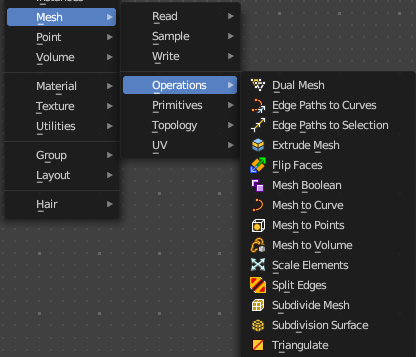
Nodes to modify the mesh geometry.
Dual Mesh
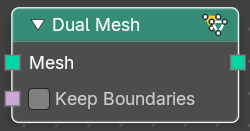
The Dual Mesh node calculates the dual of the input mesh. This means that faces get replaced with vertices and vertices with faces.
Inputs
Mesh
Data type: Geometry.
The input mesh.
Keep Boundaries
Data type: Boolean.
Keep the (non-manifold) boundaries of the mesh intact.
Outputs
Dual Mesh
Data type: Geometry.
The output mesh.
Edge Paths to Curves
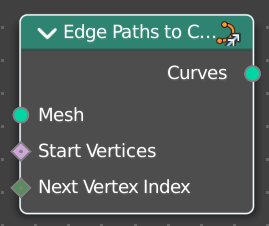
Converts Edge Paths to Curves.
Inputs
Mesh
Data type: Geometry.
The input mesh.
Start Vertices
Data type: Boolean.
The start vertices of the edge path.
Next Vertex Index
Data type: Integer.
The edge path by index.
Outputs
Curves
Data type: Geometry.
The output curve.
Edge Path to Selection
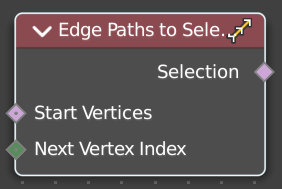
Calculates an edge path, and converts it to a selectoin
Inputs
Start Vertices
The start vertices of the edge path.
Next Vertex Index
The edge path by index.
Outputs
Selection
The selection
Extrude Mesh
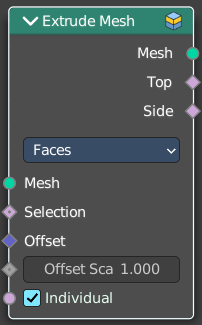
Extrudes out geometry at the selection by a given amount.
Inputs
Mesh
Data type: Geometry.
The input mesh.
Selection
Data type: Boolean.
A selection of the mesh.
Offset
Data type: Vector (translation).
The offset amount.
Offset Scale
Data type: Float.
The offset scale. Without an offset this is equal the amount.
Individual
Data type: Boolean.
Just Faces mode. Extrude out individual faces.
Properties
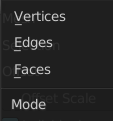
Mode
What kind of elements to extrude out. Vertices, Edges or Faces.
Outputs
Mesh
Data type: Geometry.
The output mesh.
Top
Data type: Boolean.
The top elements of the extrusion.
Side
Data type: Boolean.
The side elements of the extrusion.
Flip Faces
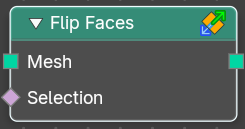
Flips the winding order of the selected faces.
Blender developers decided not to call it Flip Normals. Since "normals are
derived data, changing them is only a side effect." However, what the node does is in fact to flip the normals.
Inputs
Mesh
Data type: Geometry.
The input mesh.
Selection
Data type: Boolean.
A selection of the input mesh.
Outputs
Dual Mesh
The output mesh.
Mesh Boolean
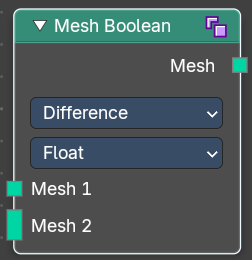
The Boolean Node allows you to cut, subtract, and join the geometry of two inputs. This node offers the same operations as the Boolean modifier.
Inputs
Mesh 1
Data type: Geometry.
Standard geometry input.
Mesh 2
Data type: Geometry.
Standard geometry input.
Self Intersect
Allow self intersection.
Hole Tolerant
Data type: Boolean.
Allow holes.
Properties
Operation
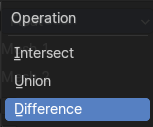
The boolean operation.
Intersect
Produce a new geometry containing only the volume inside of both geometry 1 and geometry 2.
Union
The two input pieces of geometry are joined, then any interior elements are removed.
Difference
Geometry 2 is subtracted from geometry 1 (everything outside of geometry 2 is kept).
Solver
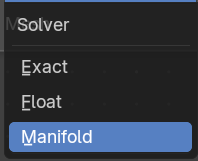
Float
Simple solver for the best performance. Does not support overlapping geometry.
Exact
Exact solver for the most accurate result.
Manifold
Fastest solver with best result, but only works on manifold meshes.
Output
Geometry
Standard geometry output.
Intersecting Edges
Data type: Boolean.
Outputs the intersecting edges.
Mesh to Curve
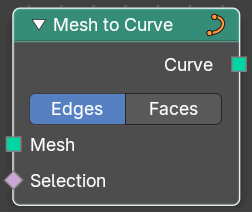
Converts a mesh geometry to a curve geometry.
Inputs
Mesh
Data type: Geometry.
Input mesh.
Selection
Data type: Boolean.
A selection of the input mesh.
Properties
Mode
Edges or Faces.
Outputs
Curve
Data type: Geometry.
Standard curve output.
Mesh to Density Grid
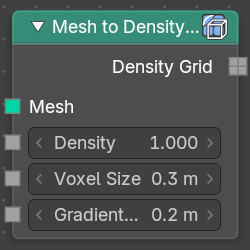
Converts a mesh geometry to a curve geometry.
Inputs
Mesh
Data type: Geometry.
Input mesh.
Density
Data type: Float.
Mesh density.
Voxel Size
Data type: Float (distance).
The vodel size.
Gradient Width
Data type: Float (distance).
The width of the gradient.
Outputs
Density Grid.
Density Grid output.
Mesh to Points
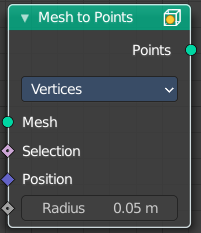
Converts a mesh geometry to a point geometry.
Inputs
Mesh
Data type: Geometry.
Input mesh.
Selection
Data type: Boolean.
A selection of the input mesh.
Position
Data type: Vector.
The position of the points.
Radius
Data type: Float (distance).
The radius of the points
Properties
Mode
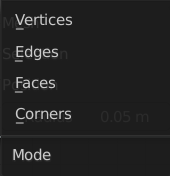
What geometry to convert to points.
Outputs
Curve
Standard curve output.
Mesh to SDF Grid
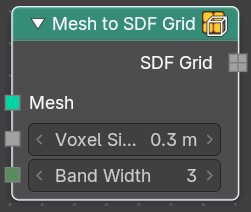
Converts a mesh geometry to a curve geometry.
Inputs
Mesh
Data type: Geometry.
Input mesh.
Voxel Size
Data type: Float (distance).
The vodel size.
Band Width
Data type: Integer.
The width of the band.
Outputs
Density Grid.
Density Grid output.
Mesh to Volume
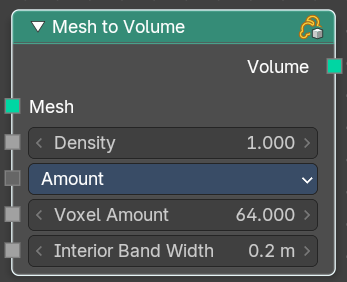
Converts a mesh geometry to a Volume.
Inputs
Mesh
Data type: Geometry.
Input mesh.
Density
Data type: Float.
The density of the volume
Resolution Mode
Data type: Menu.
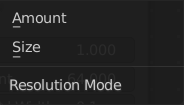
How to calculate the volume. Based of the size or based at the amount.
Voxel Amount / Voxel Size
The voxel amount / the voxel size.
Interior Bandwidth
Where to start the calculation inside of the volume.
Outputs
Volume
Data type: Geometry.
The volume output.
Scale Elements
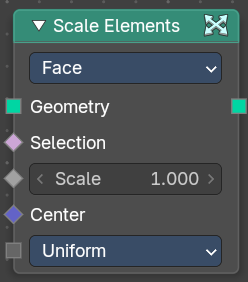
Allows to scale the selected elements.
Inputs
Geometry
Data type: Geometry.
Standard geometry input.
Selection
Data type: Boolean.
A selection of the geometry.
Scale
Data type: Float.
The scale factor
Center
Data type: Vector (translation).
The center of the scaling.
Scale Mode
Data type: Menu.
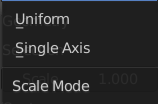
Uniform scales uniformly in all three world coordinates.
Single Axis scales separately in the single axis.
Axis
Data type: Vector.
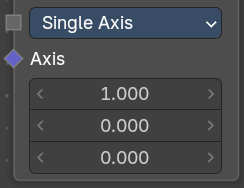
Scale Mode Single axis only. Scale the selection separately along its single axis.
Properties
Domain
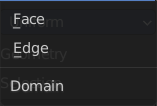
What kind of elements to scale.
Outputs
Geometry
Data type: Geometry.
The output geometry.
Split Edges
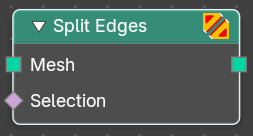
Splits the edges of the geometry.
Note that splitting edges breaks the mesh topology.
Inputs
Mesh
Data type: Geometry.
Input mesh.
Selection
Data type: Boolean.
A selection of the input mesh.
Outputs
Mesh
Data type: Geometry.
Standard Mesh output.
Subdivide Mesh
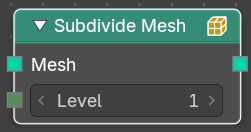
Subdivides the geometry by a simple division.
Inputs
Geometry
Standard geometry input.
Level
Data type: Integer.
To which degree the geometry will be deformed.
Outputs
Geometry
Standard geometry output.
Subdivision Surface
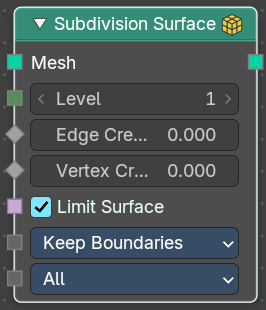
The Subdivision Surface node subdivides the geometry using Catmull-Clark deformation.
Inputs
Mesh
Data type: Geometry.
Standard geometry input.
Level
Data type: Integer.
To which degree the geometry will be deformed.
Edge Crease
Data type: Float (factor).
Control how smooth edges should be with Weighted Edge Creases.
Vertex Crease
Data type: Float (factor).
Control how smooth edges should be with Weighted Vertex Creases.
Limit Surface
Data type: Boolean.
Place the vertices at the surface as if it would be infinite subdivided. This results in the smoothest possible shape.
UV Smooth
Data type: Menu.
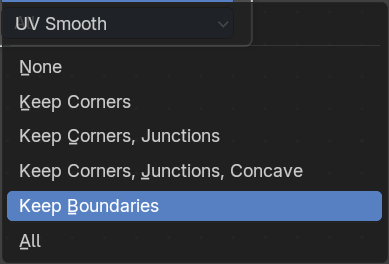
The methbod to deal with smoothing the UV.
Boundary Smooth
Data type: Menu.
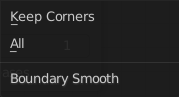
Controls if open boundaries and corners are smooth.
Outputs
Geometry
Standard geometry output.
Triangulate
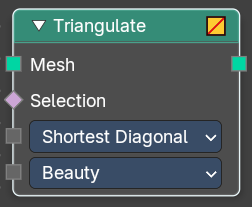
The Triangulate node triangulates all faces in a mesh.
Inputs
Geometry
Standard geometry input.
Minimum Vertices
Minimum number of vertices a face must have to be triangulated. For example, setting this value to 5, will prevent triangulation of Quads and only triangulate N-gons.
Properties
Quad Method
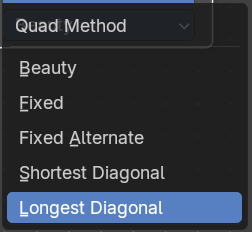
A quad is a polygon with four edges.
Beauty
Split the quads in nice triangles, slower method.
Fixed
Split the quads on their 1st and 3rd vertices.
Fixed Alternate
Split the quads on their 2nd and 4th vertices.
Shortest Diagonal
Split the quads based on the shortest diagonal distance between their vertices.
Longest Diagonal
Split the quads based on the longest diagonal distance between their vertices.
Polygon Method
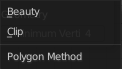
Meant are N-Gons. Faces with more than four edges. Tris, Quads and N-Gons are all Polygons.
Beauty
Arrange the new triangles nicely, slower method.
Clip
Split the polygons using an ear-clipping algorithm (gives similar results to the tessellation used for the viewport rendering).
Outputs
Geometry
Standard geometry output.
Primitives
Add menu - Mesh - Primitives
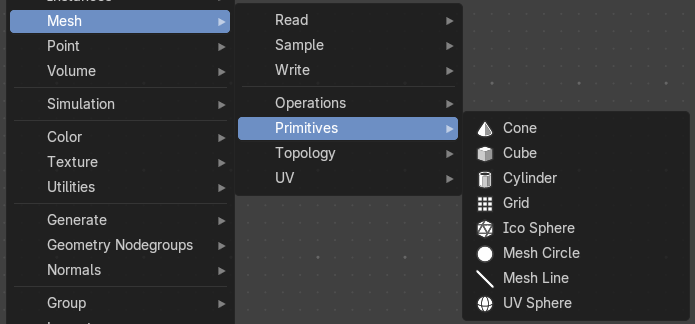
Nodes to modify the mesh geometry.
Cone
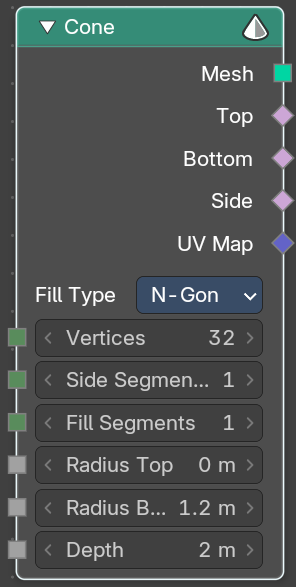
Cone creates a Cone mesh.
Input
Vertices
Data type: Integer.
Number of vertices.
Radius Top
Data type: Float (distance).
The initial radius at the top.
Side Segments
Data type: Integer.
Adjust the number of segments at the side.
Fill Segments
Data type: Integer.
Adjust the number of segments at the fill faces.
Radius Bottom
Data type: Float (distance).
The initial radius at the bottom.
Depth
Data type: Float (distance).
The initial height.
Properties
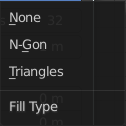
Fill Type
Defines how the Circle mesh is filled.
None
pure edge geometry.
N-Gon
The circle face is a N-Gon face.
Triangles
The circle face is triangulated.
Outputs
Mesh
Data type: Geometry.
Mesh output.
Top
Data type: Boolean.
Top radius output.
Bottom
Data type: Boolean.
Bottom radius output.
Side
Data type: Boolean.
The depth output
UV Map
Data type: Vector.
UV map output.
Cube
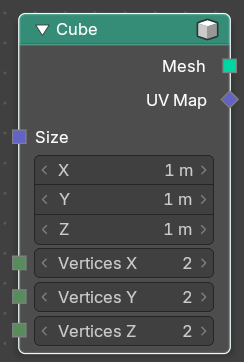
Cube creates a Cubeoid mesh.
Inputs
Size
Data type: Vector (translation).
The initial size in X , Y and Z dimensions
Vertices
How much vertices the single edges has. This allows to subdivide the cube.
Outputs
Mesh
Data type: Geometry.
Mesh output.
UV Map
Data type: Vector.
UV map output.
Cylinder
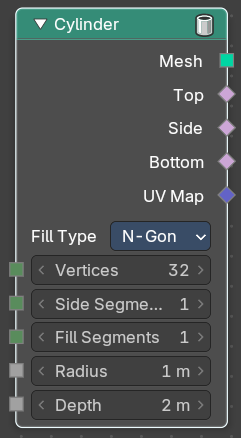
Cylinder creates a Cylinder mesh.
Input
Vertices
Data type: Integer.
Number of vertices.
Side Segments
Data type: Integer.
Adjust the number of segments at the side.
Fill Segments
Data type: Integer.
Adjust the number of segments at the fill faces.
Radius
Data type: Float (distance).
The initial radius.
Depth
Data type: Float (distance).
The initial height.
Properties
Fill Type
Defines how the Circle mesh is filled.
None
pure edge geometry.
N-Gon
The circle face is a N-Gon face.
Triangles
The circle face is triangulated.
Outputs
Mesh
Data type: Geometry.
Mesh output.
Top
Data type: Boolean.
Top radius output.
Bottom
Data type: Boolean.
Bottom radius output.
Side
Data type: Boolean.
The depth output
UV Map
Data type: Vector.
UV map output.
Grid
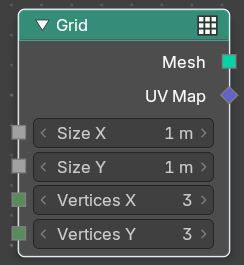
Grid creates a grid mesh.
Inputs
Size
The initial size.
Vertices X
Data type: Integer.
The initial number of vertices in X direction.
Vertices Y
Data type: Integer.
The initial number of vertices in Y direction.
Outputs
Mesh
Data type: Geometry.
Mesh output.
UV Map
Data type: Vector.
UV map output.
Ico Sphere
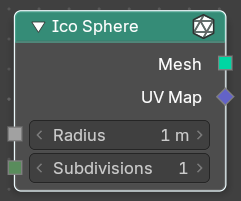
Ico Sphere creates a ico Sphere mesh.
Inputs
Radius
Data type: Float (distance).
The initial radius.
Subdivisions
Data type: Integer.
The initial subdivisions.
Outputs
Mesh
Data type: Geometry.
Mesh output.
UV Map
Data type: Vector.
UV map output.
Mesh Circle
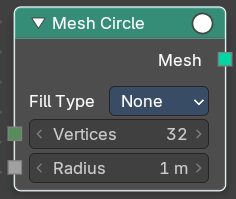
Circle creates a Circle mesh.
Input
Vertices
Data type: Integer.
Number of vertices.
Radius
Data type: Float (distance).
The initial radius.
Properties
Fill Type
Defines how the Circle mesh is filled.
None
pure edge geometry.
N-Gon
The circle face is a N-Gon face.
Triangles
The circle face is triangulated.
Outputs
Mesh
Data type: Geometry.
Mesh output.
Mesh Line
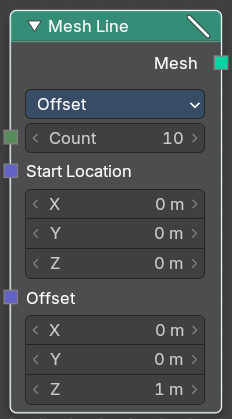
Line creates a line mesh.
Input
Count
Data type: Integer.
The initial number of segments.
Start Location
Data type: Vector (translation).
The initial location.
Offset
Data type: Vector (translation).
The initial offset.
Properties
Mode
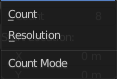
Offset
Specify the offset from one vertice to the next.
End Points
Specify the line start and endpoints.
Count ModeCount
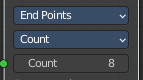
Specify the number of total vertices.
End Points
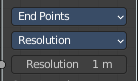
Specify the distance between the vertices.
Outputs
Mesh
Data type: Geometry.
Mesh output.
UV Sphere
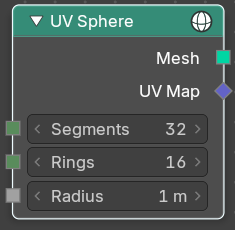
UV Sphere creates a uv sphere mesh.
Inputs
Segments
Data type: Integer.
The initial number of segments.
Rings
Data type: Integer.
The initial number of edgerings.
Radius
Data type: Float (distance).
The initial radius.
Outputs
Mesh
Data type: Geometry.
Mesh output.
UV Map
Data type: Vector.
UV map output.
Topology
Add menu - Mesh - Topology
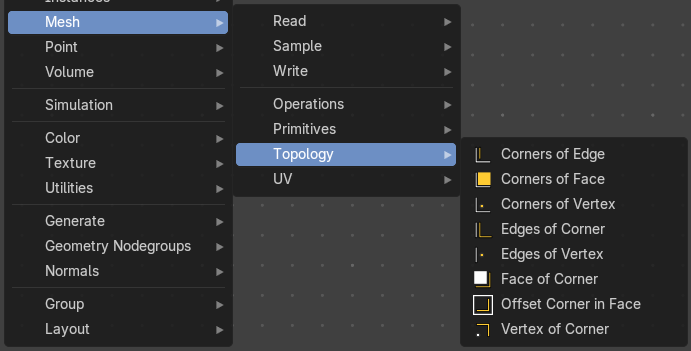
Mesh topology related nodes.
Corners of Edge
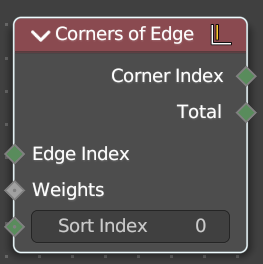
Retreive the corners that makes up a edge.
Inputs
Face Index
The face to get the data from.
Weights
Data type: Float.
Values used to sort the corners of the face.
Sort Index
Data type: Integer.
Which of the corners to output.
Outputs
Corner Index
Data type: Integer.
The output corner.
Total
Data type: Integer.
The number of corners in the face.
Corners of Face
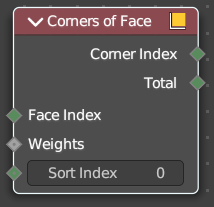
Retreive the corners that makes up a face.
Inputs
Face Index
Data type: Integer.
The face to get the data from.
Weights
Data type: Float.
Values used to sort the corners of the face.
Sort Index
Data type: Integer.
Which of the corners to output.
Outputs
Corner Index
Data type: Integer.
The output corner.
Total
Data type: Integer.
The number of corners in the face.
Corners of Vertex
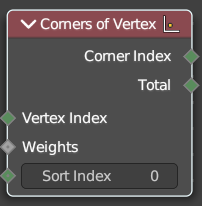
Retreive face corners connected to vertices.
Inputs
Vertex Index
Data type: Integer.
The vertice to get the data from.
Weights
Data type: Float.
Values used to sort the corners attached to the vertice.
Sort Index
Data type: Integer.
Which of the corners to output.
Outputs
Corner Index
Data type: Integer.
The output corner.
Total
Data type: Integer.
The number of corners connected to each vertice.
Edges of Corner
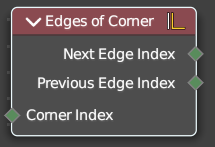
Retreive the edges of both sides of a corner.
Inputs
Corner Index
Data type: Integer.
The corner to retreive the data from.
Outputs
Next Edge Index
Data type: Integer.
The edge behind the corner.
Previous Edge Index
Data type: Integer.
The edge before the corner.
Edges of Vertex
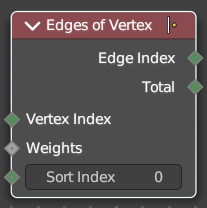
Retreive the edges connected to each vertex.
Inputs
Vertex Index
Data type: Integer.
The vertice to get the data from.
Weights
Data type: Float.
Values used to sort the edges attached to the vertice.
Sort Index
Data type: Integer.
Which of the edges to output.
Outputs
Edge Index
Data type: Integer.
The output edge.
Total
Data type: Integer.
The number of edges connected to each vertice.
Face of Corner
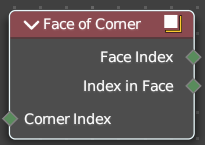
Retreive the faces connected to each corner.
Inputs
Corner Index
Data type: Integer.
The corner to get the data from.
Outputs
Face Index
Data type: Integer.
The output faces.
Index in Face
Data type: Integer.
The index of the corner, starting from the first corner in the face.
Offset Corner in Face
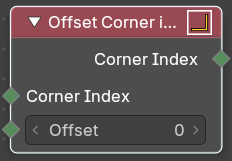
Retreive corners within the same face as another
Inputs
Corner Index
Data type: Integer.
The corner to get the data from.
Offset
Data type: Integer.
The numbers of corners to move around the face before getting the result. It circles around the start of the face if necessary.
Outputs
Corner Index
Data type: Integer.
The index of the offset corner.
Vertex of corner
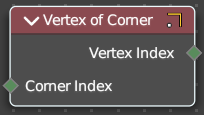
Retreive the vertex each corner is attached to.
Inputs
Corner Index
Data type: Integer.
The corner to get the data from.
Offset
The numbers of corners to move around the face before getting the result. It circles around the start of the face if necessary.
Outputs
Vertex Index
Data type: Integer.
The vertex each corner is attached to.
UV
Add menu - UV
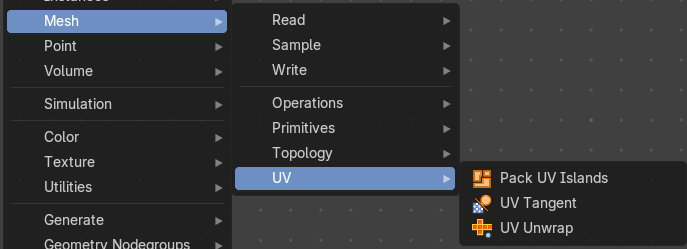
Here you find nodes to modify the UV mapping.
Pack UV Islands
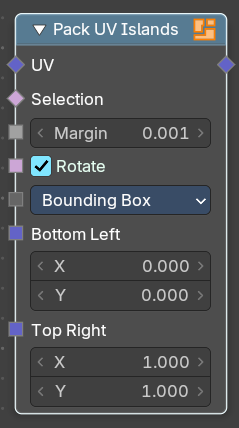
Pack the UV islands to get the most out of the UV mapping.
Inputs
UV
Data type: Vector.
The input UV geometry.
Selection
Data type: Boolean.
A selection of the UV geometry.
Margin
Data type: Float.
How big the gap between the single UV patches should be.
Rotate
Data type: Boolean.
Rotate island for best fit.
Method
Data type: Menu.
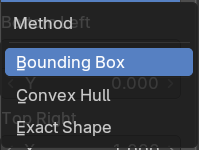
Method used for packing UV Islands.
Bottom Left
Bottom left corner of packing bounds.
Top Right
Top right corner of packing bounds.
Outputs
UV
Data type: Vector.
The output UV geometry.
UV Tangent
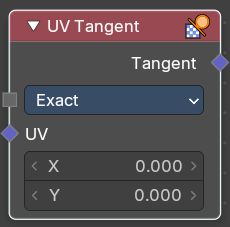
Generate tangent directions based on a UV map.
Inputs
Method
Data type: Menu.
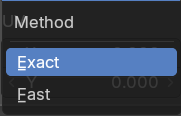
Exact or fast calculation.
UV
Data type: Vector (xyz2d).
x and y values of the UV space.
Outputs
Tangent
Data type: Vector.
The output UV geometry.
UV Unwrap
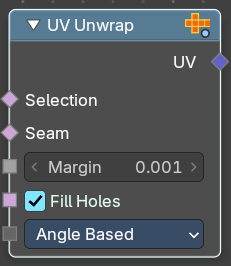
Unwrap the mesh to give it an UV mapping.
Inputs
Selection
Data type: Boolean.
Which faces of the mesh should be unwrapped.
Seam
Data type: Boolean.
Mark edges as a seam for unwrapping.
Margin
Data type: Float.
How big the gap between the single UV patches should be.
Fill Holes
Data type: Boolean.
Virtually fill holes before unwrapping the mesh. This preserves symmetry and can avoids overlaps.
Method
Data type: Menu.
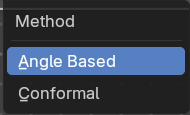
The unwrap method.
Outputs
UV
Data type: Vector.
The output UV geometry.