





































Input
Input nodes: Constant, Gizmo, Import, Scene.
Constant
Add menu - Input - Constant
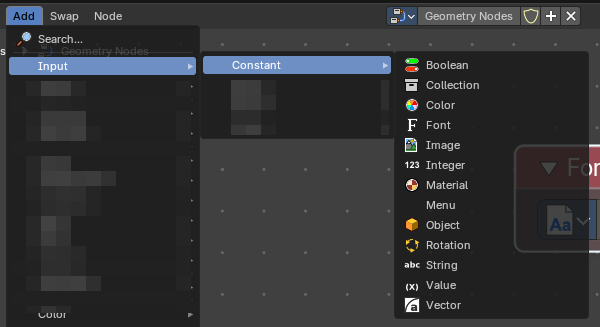
Here you find input nodes.
Boolean
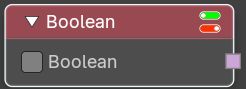
Inputs a boolean value.
Properties
Value
The input boolean.
Outputs
Boolean
Data type: Boolean.
The boolean state.
Collection
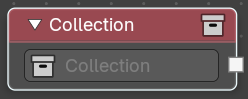
Outputs a single collection.
Properties
Collection
The collection to select from the scene.
Outputs
Collection
Data type: Collection.
The collection data useful to get instances as children.
Color
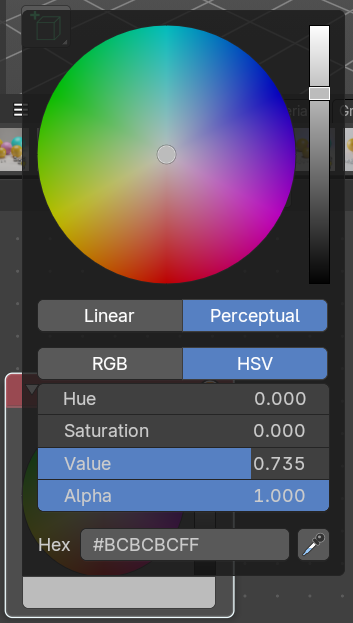
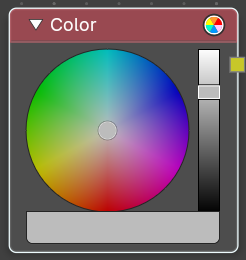
Define a input color.
This node is a color wheel.
Clicking at the color field at the bottom will reveal the standard Blender color dialog, where you can input numeric values.
Outputs
Color
Data type: Color.
Standard color output.
Font
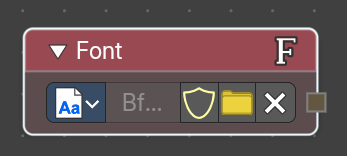
Provides a constant reference to a font data inside Geometry Nodes. Useful for procedural text generation, typography-driven effects, and node-based workflows where font consistency is required
Parameters
Font Selector
Dropdown or file browser to choose the font datablock. Can reference internal fonts or external font files.
Outputs
Provides a Font datablock reference that other nodes can consume. Typically used as input for text-related nodes.
Image
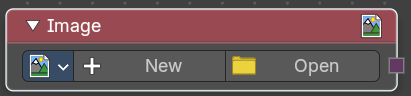
Add a input image.
Properties
Image
Load or connect a image.
New
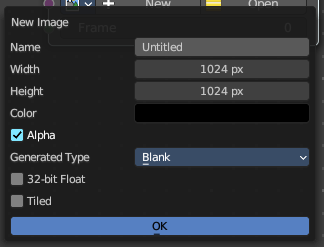
Create a new image.
Opens a new image dialog where you can adjust the color, size and further settings.
Open
Open a existing image.
Image prop
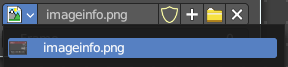
Image browser
A list of available images
Image name
The name of the image
Fake user
Add a fake user to this asset.
New
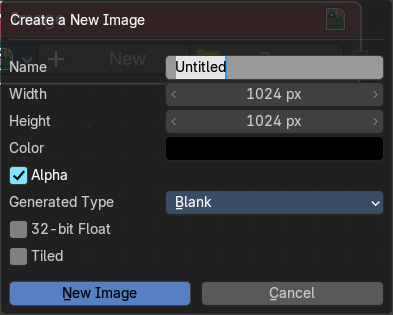
Create a new image.
Opens a new image dialog where you can adjust the color, size and further settings.
Open Image
Open a existing image.
Remove
Removes the image as the active image.
Frame
For videos. Which frame to use.
Outputs
Image
Data type: Image.
The output image.
Integer
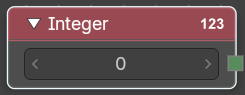
Inputs a integer value.
Properties
Value
The input integer.
Outputs
Integer
Data type: Integer.
The integer value.
Material
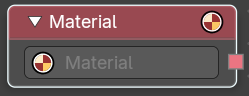
Retreive a material.
Outputs
Material
Data type: Material.
The material output.
Object
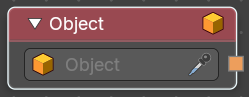
Retrieves a single object.
Properties
Object
The object to select from the scene.
Outputs
Object
Data type: Object.
The object data useful to get object info.
Rotation
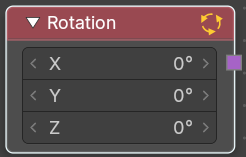
Apply a constant rotation.
Properties
X, Y Z
The rotation that you want to apply.
Outputs
Rotation
Data type: Rotation.
The output rotation vector.
String
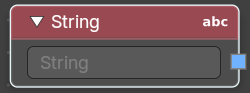
Input a string.
Properties
String
The string that you want to input.
Outputs
Value
The value set in the node properties.
Value
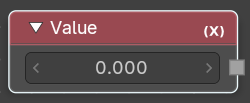
Input numerical values to other nodes in the tree.
Properties
Value
Single numerical value (floating point).
Outputs
Value
Data type: Float.
The value set in the node properties.
Vector
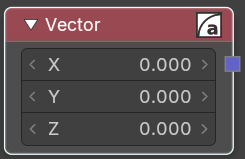
Creates a single vector of three values that can be used as an input.
Properties
X Y Z
The values of the vector.
Outputs
Vector
Data type: Vector.
Standard vector output.
Gizmo
Add menu - Input - Gizmo
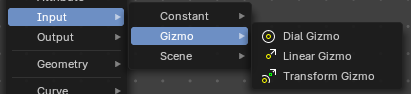
Here you find input nodes.
Dial Gizmo
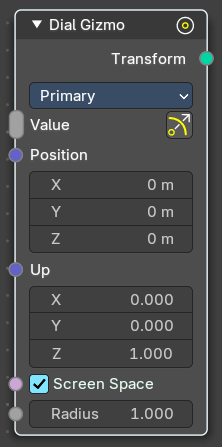
Displays the rotation gizmo in the 3d view.
Inputs
Value
Data type: Float.
Show or hide the widget.
Position
Data type: Vector (translation).
Where to show the widget in relation to the object.
Up
Data type: Vector (XYZ).
The up vector to define the rotation.
Screen Space
Data type: Boolean.
Use screen space or object space values to display the widget.
Radius
Data type: Float.
The radius of the widget.
Properties
Color
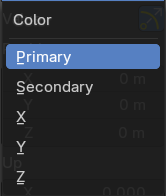
The widget color, defined in the theming.
Pin Gizmo
Always display the gizmo.
Outputs
Transform
Data type: Geometry.
The output transform. No positions, no matrices, Gizmos.
Linear Gizmo
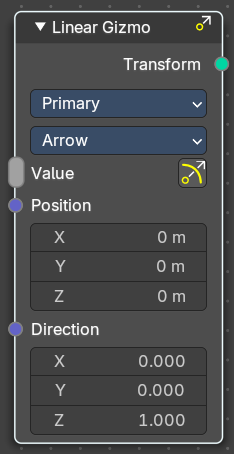
Displays the translation gizmo in the 3d view.
Inputs
Value
Data type: Float.
Show or hide the widget.
Position
Data type: Vector (translation).
Where to show the widget in relation to the object.
Direction
Data type: Vector (XYZ).
The direction vector.
Screen Space
Use screen space or object space values to display the widget.
Radius
The radius of the widget.
Properties
Color
The widget color, defined in the theming.
Draw Style
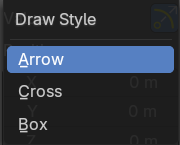
How to draw the widget.
Pin Gizmo
Always display the gizmo.
Outputs
Transform
Data type: Geometry.
The output transform. No positions, no matrices, Gizmos.
Transform Gizmo
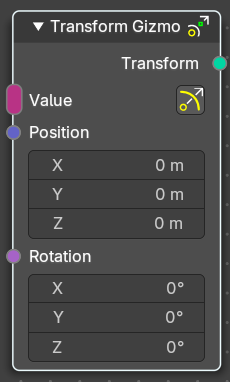
Displays the transform gizmo in the 3d view.
Inputs
Value
Data type: Matrix.
Show or hide the widget.
Position
Data type: Vector (translation).
Where to show the widget in relation to the object.
Rotation
Data type: Rotation.
The rotation vector.
Screen Space
Use screen space or object space values to display the widget.
Radius
The radius of the widget.
Properties
Pin Gizmo
Always display the gizmo.
Outputs
Transform
Data type: Geometry.
The output transform. No positions, no matrices, Gizmos.
Import
Add menu - Input - Import
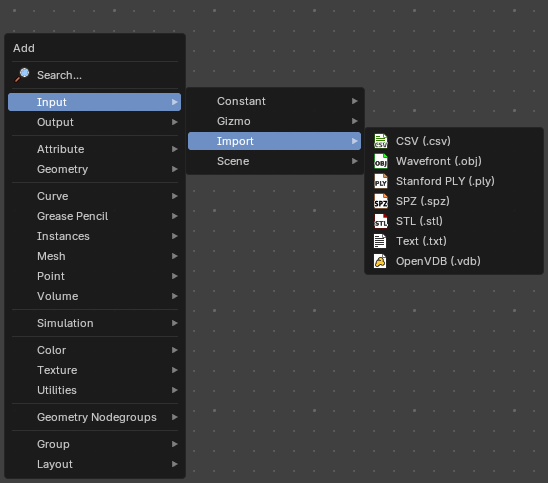
Here you find import nodes. These are useful for importing file based data into the Geometry Nodes trees.
Import CSV (.csv)
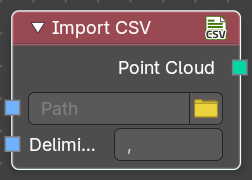
The Import CSV node is used to bring structured tabular data into Geometry NOdes, particularly for workflows involving point cloud generation. You can select a CSV file, specify the appropriate delimiter, and extract formatted data to use in the node tree.
Inputs
Path
Specifies the location of the CSV file to be imported. This can also be a string input.
Open
Includes a folder icon button for browsing files.
Delimiter
Defines the character separating values in the CSV file. Default value is a comma (,). The Delimiter field determines how data is parsed from the fil
Outputs
Generates a point cloud data type from the imported CSV file.
Import Wavefront (.obj)
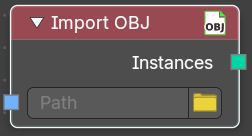
The Import OBJ node is used to load Wavefront OBJ files into Geometry Nodes, allowing you to integrate external 3D models into the Geometry Nodes tree. Useful for importing static meshes into a procedural workflow
Inputs
Path
Specifies the location of the OBJ file to be imported. This can also be a string input.
Open
Includes a folder icon button for browsing files.
Outputs
Instances
Outputs the imported OBJ file as an instance within the node tree. You can later realize the instance for mesh data.
Import Standford (.ply)
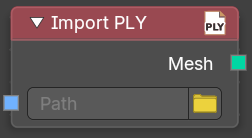
The Import PLY node is used to bring Polygon File Format (PLY) meshes into Geometry Nodes, facilitating workflows that incorporate 3D scanned data or procedural mesh generation. It allows you to load PLY files with vertex color and geometry information into the Geometry Nodes node tree.
Inputs
Path
Specifies the location of the PLY file to be imported. This can also be a string input.
Open
Includes a folder icon button for browsing files.
Outputs
Mesh
Outputs the imported PLY file as a mesh, including vertex positions, colors, and potential additional attributes.
Import SPZ (.spz)
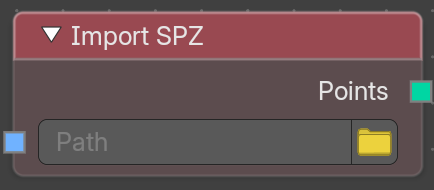
Loads an SPZ file as a point cloud that is shown as a 3D Gaussian Splat. The file is read again only when the path changes.
If your version of Bforartists was built without SPZ support, the node shows the error "Disabled, Blender was compiled without SPZ I/O".
Inputs
Path
The path to the SPZ file. Use the folder button to browse for a file. Only files that end with .spz are offered.
Outputs
Points
The imported point cloud. Warnings from the import are shown on the node.
Import STL (.stl)
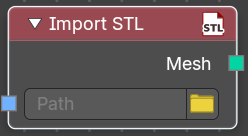
The Import STL node is used to bring Stereolithography (STL) files into Geometry Nodes, making it ideal for workflows involving 3D printing, CAD models, and mesh-based processing. This node allows you to load STL files and integrate them into Geometry Nodes tree.
Inputs
Path
Specifies the location of the STL file to be imported. This can also be a string input.
Open
Includes a folder icon button for browsing files.
Outputs
Mesh
Outputs the imported STL file as a mesh. Typically this may be curve data, so you can use the Mesh to Curve node to convert to curves without a problem.
Import Text (.txt)
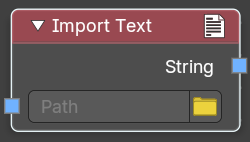
The Text Node is used to generate and manipulate text within Geometry Nodes. It allowsyouto input and format text dynamically, making it useful for procedural labeling, engraving, and other text-based effects.
Inputs
Path
Specifies the location of the TXT file to be imported. This can also be a string input.
Open
Includes a folder icon button for browsing files.
Outputs
String
Outputs the imported text file as string value.
Import OpenVDB (.vdb)
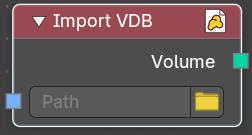
The** Import VDB node is used to bring OpenVDB volumetric data **into Geometry Nodes, making it an essential tool for fluid simulations, smoke, and cloud-based effects. It allowsyouto import voxel-based data and integrate it into procedural workflows.
Inputs
Path
Specifies the location of the VDB file to be imported. This can also be a string input.
Open
Includes a folder icon button for browsing files.
Outputs
Volume
Outputs the imported VDB file as a volumetric grid, which can be modified within the node tree.
Scene
Add menu - Input - Scene
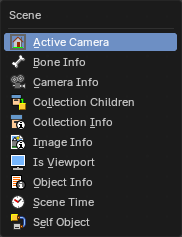
Here you find input nodes.
Active Camera
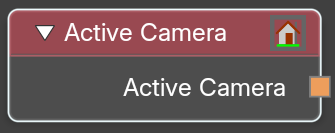
The node outputs the the scene's current active camera.
Typical usage would be to connect this node to an Object Info node to
obtain its transform.
Outputs
Active Camera
Data type: Object.
The active camera.
Camera Info
The node outputs settings from the chosen camera.
Typical usage would be to connect this node to an Object Info node to
obtain its transform.
Inputs
Camera
Data type: Object.
The camera object.
Outputs
—
Projection Matrix
The projection matrix.
Focal length
The focal length.
Sensor
The sensor size.
Shift
The camera shift.
Clip Start
The camera near clipping distance.
Clip End
The camera far clipping distance.
Focus Distance
Distance to the focus point for depth of field.
Is Orthographic
If the camera is using orthographic view.
Orthographic Scale
The orthographic camera scale in case it is using Orthographic view.
Collection Info
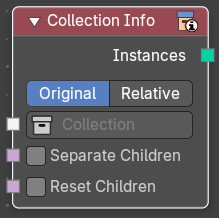
The Collection Info node retreives information from collections. This can be useful to use an external collection to control parameters in the geometry node tree.
Inputs
Collection
Data type: Collection.
Collection to get the properties from.
Separate Children
Data type: Boolean.
Output each child of the collection as a separate instance. The output is sorted alphabetically.
Reset Children
Reset the transform of every child instance in the output. This setting is just active when Separate Children is active.
Properties
Transform Space
The transformation of the geometry outputs.
Original
Output the geometry relative to the collection offset.
Relative
Bring the input collection geometry into the modified object, maintaining the relative position between the objects in the scene.
Outputs
Geometry
Geometry of the collection in world space with all its modifiers applied.
Image Info
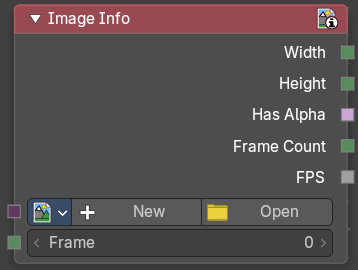
Retreive infos from an image.
Input
Image
Data type: Image.
Load or connect a image.
New
Create a new image.
Opens a new image dialog where you can adjust the color, size and further settings.
Open
Open a existing image.
Image prop
Image browser
A list of available images
Image name
The name of the image
Fake user
Add a fake user to this asset.
New
Create a new image.
Opens a new image dialog where you can adjust the color, size and further settings.
Open Image
Open a existing image.
Remove
Removes the image as the active image.
Frame
Data type: Integer.
For videos. Which frame to use.
Outputs
Width
Data type: Integer.
The width of the image.
Height
Data type: Integer.
The height of the image
Has Alpha
Data type: Boolean.
Returns true if the image has an alpha channel
Frame Count
Data type: Integer.
For movies. How many frames.
FPS
Data type: Float.
For movies, what FPS rate.
Is Viewport
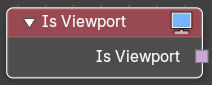
The Is Viewport node outputs true when geometry nodes is evaluated for the viewport. For the final render the node outputs false.
Outputs
Is Viewport
Data type: Boolean.
A booleran that indicates if the geometry nodes is evaluated for preview.
Object Info
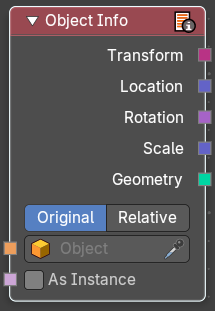
The Object Info node retreives information from objects. And outputs it then.
Inputs
Object
Data type: Object.
Object to get the properties from.
Outputs
Transform
Data type: Matrix.
Transform matrix output.
Location
Data type: Vector.
Location of the object in world space.
Rotation
Data type: Rotation.
Rotation of the object in world space.
Scale
Data type: Vector.
Scale of the object in world space.
Geometry
Data type: Geometry.
Geometry of the object in world space with all its modifiers applied.
Scene time
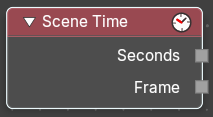
Outputs the current scene time in seconds or in frames.
The Frame output is a float value to make subframe rendering for motion
blur possible.
Outputs
Seconds
Data type: Float.
Output in seconds.
Frame
Data type: Float.
Output in Frames.
Self Object
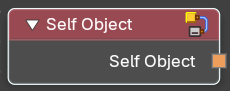
Retreives the parent object of the geometry nodegroup.
Collection Children
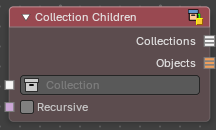
Lists the objects and the collections that sit inside a collection, sorted by name. Use it to loop over everything in a collection, for example to instance every object it holds. With Recursive on, the node also looks inside the collections it finds.
Inputs
Collection
Data type: Collection.
The collection to look into.
Recursive
Data type: Boolean.
On: also include the children of child collections.
Outputs
Collections
Data type: Collection list.
The child collections.
Objects
Data type: Object list.
The child objects.